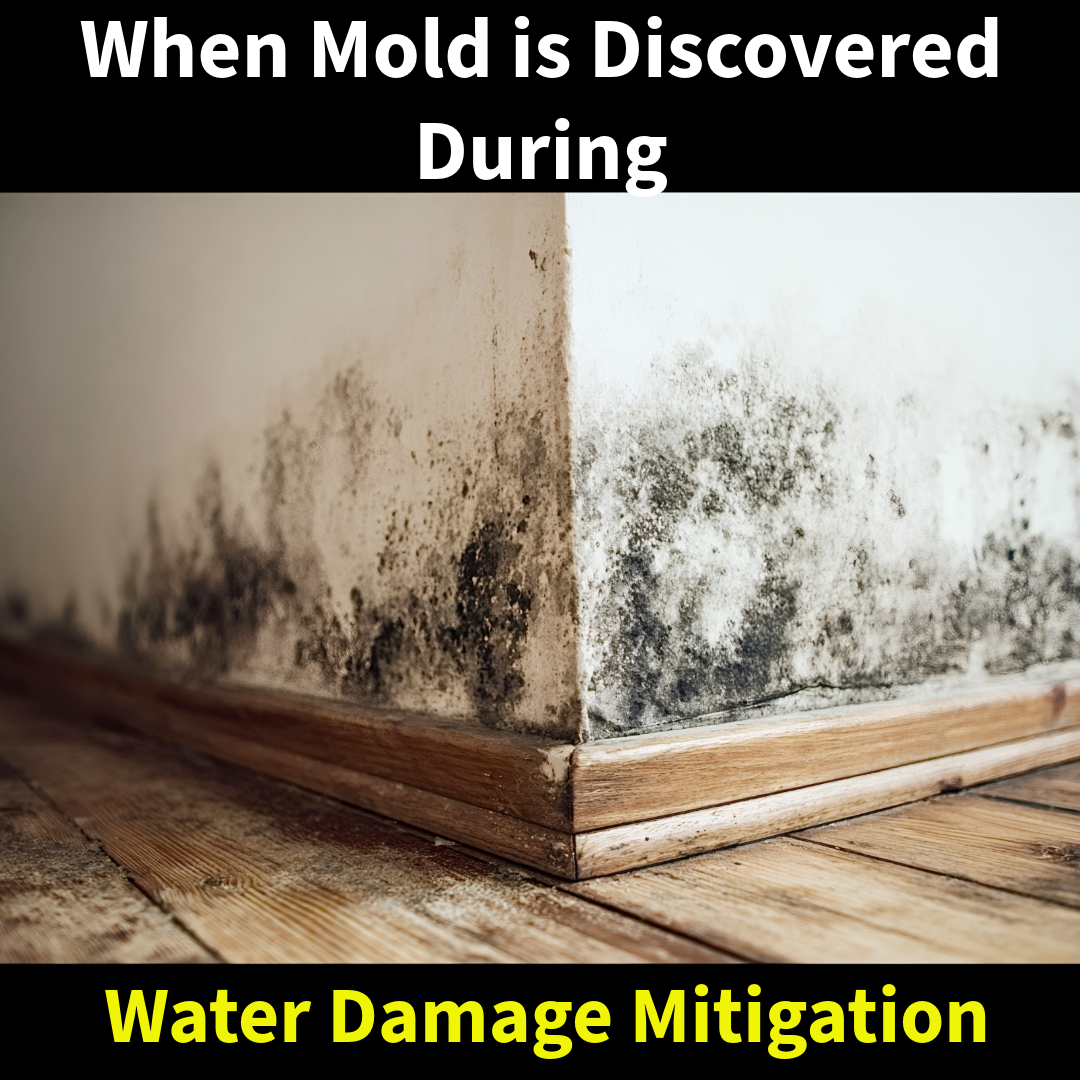
When Mold Is Discovered During Water Damage Mitigation

Water damage jobs don’t always end with drying equipment and reconstruction. Sometimes, they uncover something that was already there. We recently responded to a basement flood where a supply line had broken and water spread into a finished area. The homeowner acted quickly and called for emergency mitigation and our team arrived shortly after and extraction began. What we found after removing baseboards and opening wall cavities changed the scope of the job entirely. There was mold growth present that clearly predated the current water loss.

And that’s something most homeowners don’t expect.


There’s a common misconception that mold appears instantly after water damage. While microbial growth can begin developing within 24–48 hours under the right conditions, visible and established growth throughout wall cavities does not form in just a few hours.

In this case, we arrived quickly — well within the window where new mold would have developed. The condition we observed indicated previous moisture exposure. That distinction matters.


When mitigation begins, affected materials must be removed to properly dry the structure. This often includes:

  • Baseboards
  • Sections of drywall
  • Flooring materials
  • Insulation

Once materials are opened, hidden conditions are revealed. It is not uncommon for older, previously undetected mold growth to be discovered during this process — especially in basements where prior leaks, humidity issues, or undocumented water events may have occurred.


When mold is discovered during a water damage job, there are typically three possibilities:

  1. It developed from a previous water event that was never properly dried.
  2. It formed from long-term humidity or moisture intrusion.
  3. It is related to the current loss — but only if sufficient time has passed.

Proper documentation and a thorough inspection are critical when mold is discovered during a water damage project. Evaluating the condition of materials, the extent of growth, and the overall moisture environment helps ensure the issue is addressed correctly and completely. At that point, the job is no longer just about drying the structure — it also involves properly removing mold that may have been overlooked during a previous water event or identifying an unforeseen moisture source that could still be active.


Water damage mitigation is not just about removing water and setting equipment. It requires:

  • Careful inspection
  • Controlled demolition
  • Moisture mapping
  • Documentation
  • Understanding building science

When mold is uncovered, the scope of work changes. Remediation protocols must be implemented to prevent cross-contamination and to address affected materials correctly. Ignoring hidden mold does not make it go away. Covering it up creates bigger problems later.


Sometimes a water damage call reveals more than just wet materials. It can uncover previous moisture issues, incomplete repairs, or conditions that were never properly addressed. That’s why a thorough approach matters.

If you experience a water event, it’s not just about drying what you can see. It’s about understanding what may already be behind the walls.

Emergency Water Damage in Villanova Leads to a Seller’s Disclosure Issue

Nine months after purchasing her first home in Villanova, a single mother found herself dealing with a basement flood. She had recently gone through a divorce, had no family living nearby, and was navigating homeownership entirely on her own. A supply line connected to her water softener broke and flooded nearly half of the basement.

She discovered the water quickly, but not before it spread into a finished room, damaging baseboards, drywall, flooring, and personal contents. A neighbor, whose home we had previously helped, referred her to our team, and we were on site within two hours. We documented damaged contents, began water extraction, and began to prep for the necessary demo. At first glance, it appeared to be a straightforward emergency water damage mitigation job.

It wasn’t.


As part of proper mitigation protocol, we removed baseboards to inspect for hidden moisture behind the walls. That’s when we found mold growth throughout multiple areas of the basement. Because we had arrived within two hours of the loss, we knew something immediately: mold does not grow that fast. Even under ideal conditions, it takes time. This wasn’t from the current flood. It was already there.


After remediation was completed, she spoke with neighbors and learned that the previous owners had experienced two prior basement floods. One was caused by a frozen pipe. The other involved the same water softener system. Neither incident had been disclosed during the sale.

The mold we uncovered was consistent with prior water events that had either been improperly dried or never professionally remediated. The issue ultimately led her to pursue action related to non-disclosure, and the matter was later resolved before going to court. For someone already rebuilding her life and managing everything independently, discovering hidden damage in her first home was not just a structural issue — it was personal and financial stress layered on top of an already major life transition.


This single case touches on three important issues homeowners should understand.

1. Emergency Water Damage Requires Immediate Response

Arriving within hours makes a difference. Quick extraction and drying limit structural damage and reduce the likelihood of new mold growth. Speed matters.

2. Mold Often Reveals a Bigger History

When mold is found during mitigation, it does not automatically mean it grew from the current event. Sometimes it exposes a previous water loss that was never properly addressed. Removing baseboards, inspecting wall cavities, and documenting conditions thoroughly protects homeowners — especially when prior damage may not have been disclosed.

3. Seller Disclosure Is Not Optional

Prior flooding and water damage history must be disclosed during a real estate transaction. Undisclosed issues can lead to expensive repairs and legal disputes. Many times, mold discovered during a new water event is actually evidence of an older problem that was hidden.


What began as a routine emergency water damage call in Villanova uncovered long-standing mold and a prior history of flooding that had not been shared. Water damage doesn’t just affect materials. Sometimes it uncovers the past.

If your basement floods, the goal isn’t just to dry what you see — it’s to investigate what may already be there.